

The Media Production & Technology Show London Recap
Anna Stesova, Blueberry’s Senior Agent, attended the 2026 Media Production and Technology Show (MPTS) at Olympia this month to learn about current industry trends. Here’s what she brought back to share…

UK Production: State of the Nation – Reset, Recovery & Reinvention
Paula Cuddy, Co-CEO – Eleventh Hour Films
Tom Garton, Director of Development – Wonderhood Studios
Alex Coffey, Managing Director – 53 Degrees Global
The panel discussion explored the current state of the UK television production industry, focusing on how producers are adapting to major structural shifts in commissioning, financing, audience behavior, and technological change. The overall theme was one of “reset, recovery, and reinvention,” with panelists emphasizing that the industry is unlikely to return to its previous model and that survival now depends on flexibility, diversification, and entrepreneurial thinking.
A key point throughout the discussion was that traditional TV production alone is no longer enough to sustain businesses. Several companies described how they had diversified into drama, digital content, podcasts, social media production, and streaming platforms in order to create multiple income streams. Alex from 53 Degrees explained that their company expanded beyond traditional factual television into drama and digital media because factual commissions had become much harder to secure. Their digital strategy includes podcasts, YouTube channels, social media management, and monetizing archive content. He stressed that success in digital requires patience, audience-building, and strong marketing investment.
Tom from Wonderhood highlighted how audience habits have fundamentally changed. Viewers are no longer automatically “glued” to television and instead divide their attention between TV, YouTube, TikTok, Instagram, and other platforms. As a result, producers must now create “event television” — shows compelling enough to make audiences actively choose to watch. Wonderhood’s move into scripted drama came naturally from wanting to tell powerful stories in the best possible format rather than from a deliberate strategy to enter drama production.
Paula from 11th Hour Films discussed the long and often unpredictable journey of scripted television development. She emphasized the importance of “planting your own green shoots” by continuing to invest in development and talent even during difficult periods. She described the complicated path of the BBC drama Rebus, which moved between broadcasters and financing partners before eventually succeeding with BBC Scotland. Her story illustrated how producers must constantly pivot, renegotiate rights, and rebuild financing structures when platforms or business models change.
Several major challenges facing the industry were repeatedly identified:
- Rising production costs, especially in scripted drama.
- Reduced commissioning from broadcasters and streamers.
- Longer development timelines.
- Greater risk placed on producers.
- Increased pressure to package projects with talent, IP, and financing before pitching
- The decline of long-running unscripted formats that sustained production companies.
The panel also discussed financing in detail. Broadcasters are often contributing only part of a production budget, forcing producers to seek co-producers, distributors, tax credits, international partners, or brand funding to close the gap. Tax credits were described as essential to making many UK dramas financially viable, particularly lower-budget productions.
Another important topic was development strategy. The panelists explained that development has become far more expensive and resource-intensive than before. Producers now have to be selective about which ideas they pursue, often involving broadcasters early to gauge commercial potential before investing heavily. Smaller companies can no longer afford large speculative development teams and instead focus resources only on projects with strong market signals.
The discussion concluded with advice for emerging producers and writers. The panel encouraged newcomers to:
- Be fearless and driven by passion for their ideas.
- Stay commercially aware while remaining creatively ambitious.
- Build relationships with production companies and broadcasters.
- Be adaptable and willing to rethink traditional production models.
- Critically evaluate whether an idea genuinely stands out in a crowded market.
Overall, the talk painted a realistic but optimistic picture of the UK production industry: one that is under pressure but still full of opportunity for companies and creators willing to evolve with changing audience behaviors and business realities.
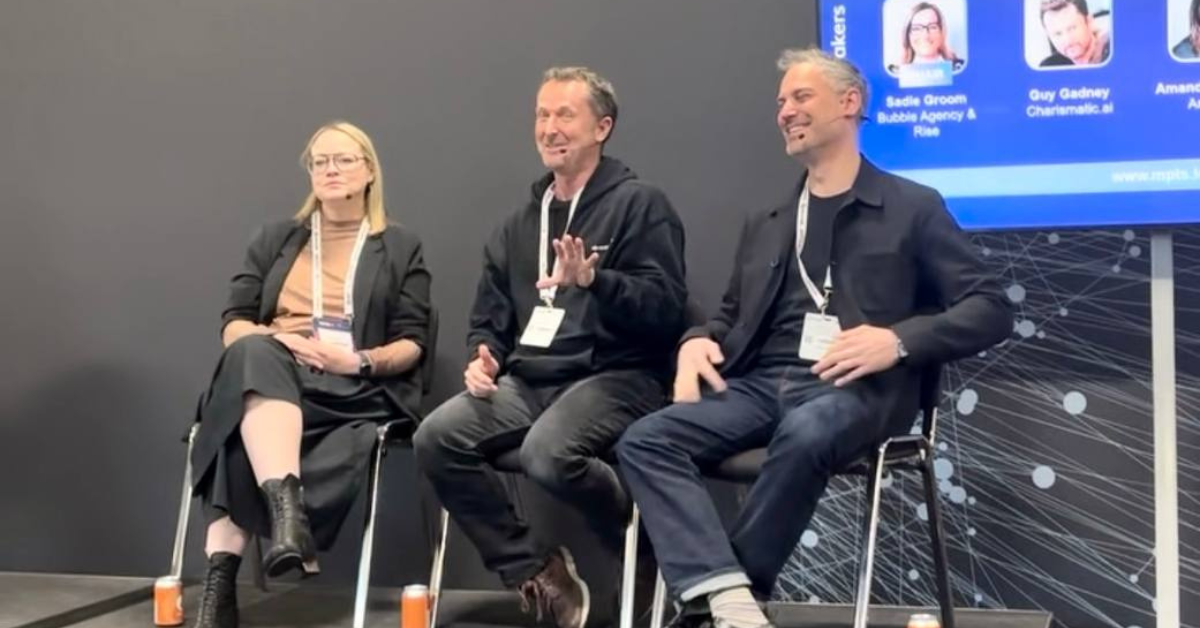
AI Ethics & Copyright: Who’s Really In Control?
Guy Gadney, CEO – Charismatic.ai
Amanda Goddard, Chief Legal & Commercial Officer – Argonon
Robert Guthrie, Partner – Osborne Clarke LLP
Thierry Levy, Head of Production – Blind Pig
The panel discussion focused on the rapidly evolving relationship between artificial intelligence, copyright law, ethics, and media production. Bringing together lawyers, AI developers, and creative industry professionals, the conversation explored how the television and creative sectors are struggling to balance innovation with legal protection, transparency, and creative integrity.
One of the central themes was the lack of clear regulation surrounding AI-generated content and training data. The panel explained that governments, particularly in the UK, are currently taking a “wait and see” approach to AI regulation. This has created uncertainty for producers, broadcasters, artists, and AI companies alike. Amanda, a media lawyer, criticized this approach, arguing that the government is effectively forcing industries to solve the problem themselves without creating adequate safeguards.
A major focus of the discussion was how AI challenges the foundations of existing copyright law. The panel explained that copyright systems in the UK, US, and Europe are built around the principle of human creativity — the idea that copyright protects original intellectual and creative input made by people. AI-generated work complicates this because modern generative systems can create scripts, images, music, and video with limited direct human authorship.
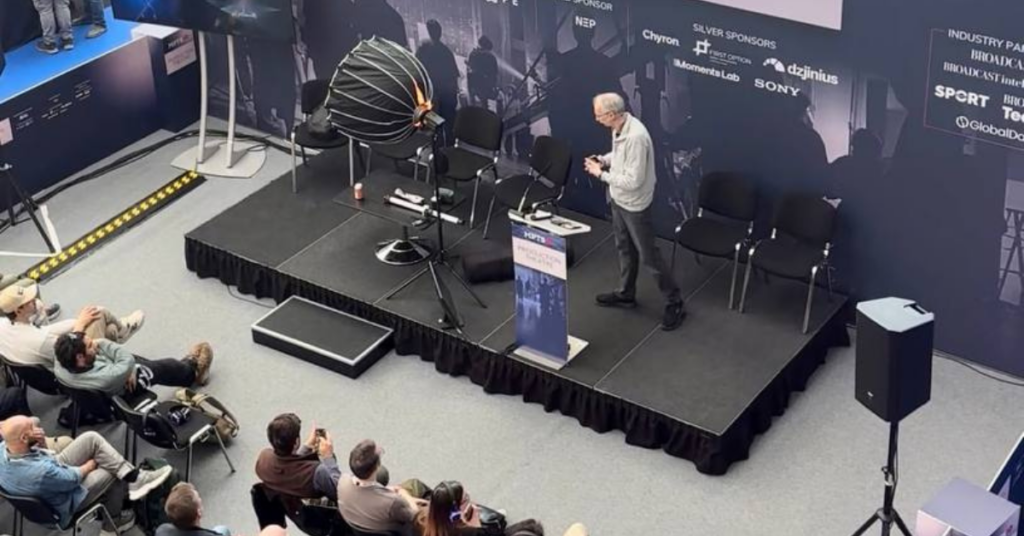
Robert Guthrie explained that this creates a major legal “grey area.” Courts and regulators are now trying to determine:
- how much human involvement is needed for copyright protection,
- whether prompting an AI system counts as creative authorship,
- and whether AI-generated works can legally qualify for copyright at all.
This uncertainty creates practical problems for producers because broadcasters and insurers rely on clear “chain of title” ownership. If it is unclear who owns AI-generated content, productions become legally riskier and harder to finance or distribute internationally.
The panel repeatedly returned to the issue of AI training data and whether creators should be compensated when their work is used to train models. Legal and ethical concerns included:
- AI systems being trained on copyrighted material without permission,
- lack of transparency around datasets,
- the difficulty of tracing copyrighted work inside AI systems,
- risks of AI reproducing protected material,
- the growing threat of misinformation, impersonation, and fraud through synthetic media.
The Getty Images legal case was discussed as an example of how difficult it is to prove copyright infringement when AI training often happens internationally. Panelists noted that creators currently have very limited ways of knowing whether their work has been used in training models.
Another key theme was ethics and responsible production practices. Several speakers described building internal ethical frameworks and risk-assessment systems for AI usage. Rather than fully replacing artists, many studios are using “integrated AI,” where AI tools assist human creators instead of replacing them entirely.
Examples of responsible AI workflows included:
- restricting staff to approved AI software,
- using closed or licensed datasets,
- tracking prompts and workflows,
- conducting ethical “consequence scanning,”
- and combining AI outputs with extensive human creative finishing.
Thierry from the animation industry emphasized that AI is not simply “cheap and fast.” In many cases, AI only produces work that is 70–80% complete, with significant artistic refinement still required from human creators. The panel strongly rejected the simplistic assumption that AI will automatically replace creative jobs.
The discussion also explored audience trust and disclosure. Some panelists argued that AI-generated content should always be labeled, particularly when realistic digital replicas or synthetic performances are involved. Others suggested that entirely human-made content may eventually become the premium product, similar to “organic” labeling in food industries.
Overall, the panel presented AI as both an opportunity and a challenge. While most agreed that the technology is unavoidable and potentially transformative, they stressed that the future of creative industries depends on developing ethical systems, transparent workflows, and legal frameworks that continue to recognize and reward human creativity.
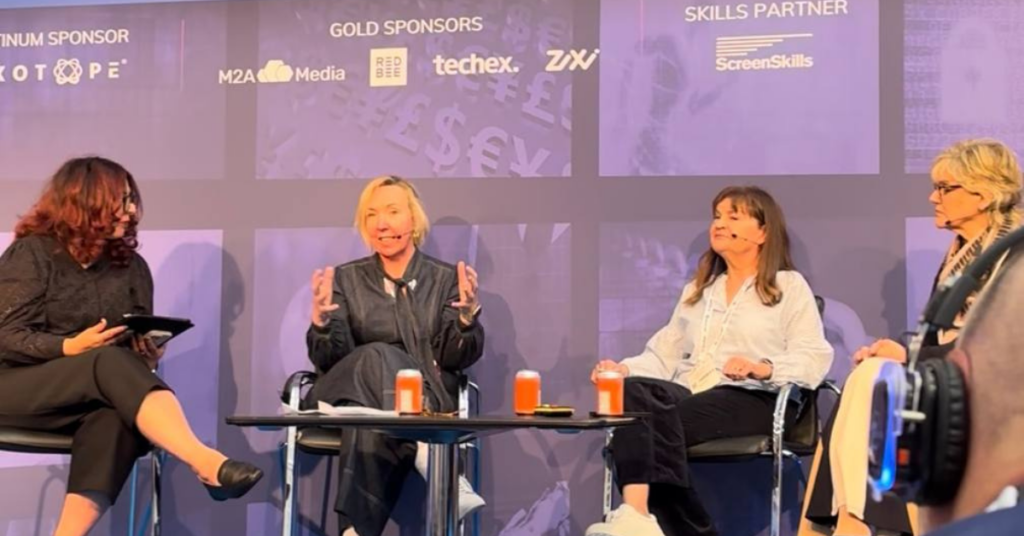
Skilling Up & Skilling Sideways
Lorna MacDonald, Head of Production Capability for Media Operations – BBC
Morwen Williams, Director of Media Operations – BBC
Emma Turner, Head of Film, Animation & Future Skills – ScreenSkills
The panel focused on how careers in television and media are evolving in response to rapid technological change, shifting industry structures, and new workplace expectations. Representatives from the BBC and ScreenSkills discussed how professionals can remain adaptable in an industry increasingly shaped by AI, automation, and multi-skilled production environments. The overall message was that modern media careers are no longer linear, and success now depends on curiosity, flexibility, and continuous learning.
A major theme throughout the discussion was the idea of the “squiggly career” — the notion that career progression is no longer simply about climbing upward through one specialist path. Instead, panelists encouraged people to move sideways, experiment with different roles, and develop broad transferable skills before specializing.
Lorna McDonald from the BBC argued that while technology changes quickly, many core career-building habits remain constant. She emphasized:
- understanding your strengths,
- building relationships and networks,
- staying curious,
- and being willing to take risks and try unfamiliar opportunities.
Similarly, Anna Turner from ScreenSkills stressed the importance of “being curious” at every stage of a career. She described how some of the most valuable learning comes from observing other departments and exploring unfamiliar roles. The panel repeatedly encouraged attendees not to limit themselves to a single career identity too early.
Another key discussion focused on transferable and “soft” skills. While technical skills are important, the panel argued that industries increasingly value communication, collaboration, leadership, and problem-solving. Anna explained that employers can often teach technical systems, but attitudes and interpersonal skills are much harder to train. Experience in customer service, hospitality, education, or other industries was presented as highly valuable because it develops confidence, adaptability, and people skills.
The conversation also explored how AI and automation are reshaping entry-level work. The panel acknowledged concerns that some junior roles may disappear as AI tools become more common, but they argued that human-centered skills will remain essential. AI may automate repetitive tasks, but it cannot replace emotional intelligence, teamwork, leadership, or creative judgment. The speakers encouraged all professionals to develop at least a basic understanding of AI tools and workflows, as broadcasters and production companies increasingly expect employees and freelancers to understand responsible AI usage.
A recurring point was the importance of broad foundational training. Morwen Williams from BBC Media Operations explained that many operational staff are now trained across multiple disciplines before later specializing in one area. This approach helps workers remain adaptable as technologies and production methods evolve.
The panel also highlighted the growing importance of leadership and management skills. Research from ScreenSkills identified leadership shortages across the industry, particularly among people capable of managing teams effectively while also understanding creative and technical workflows. The speakers noted that poor management can strongly affect workplace culture and career satisfaction, making leadership a skillset in its own right rather than simply a promotion from technical work.
Finally, the panel encouraged professionals at all stages of their careers to remain open to reinvention. Whether through side projects, temporary placements, job shares, or career pivots, the speakers emphasized that long-term career resilience comes from adaptability rather than rigid specialization. Overall, the discussion presented modern media careers as increasingly flexible, collaborative, and interdisciplinary, requiring both technical confidence and strong human skills to succeed.
From ScreenSkill’s latest article here are the main skills gaps right now
The biggest shortages are in mid-level “step-up” roles, especially:
- VFX supervisors
- Post-producers
- Production coordinators
- Producers
- Unscripted TV directors
The most commonly identified skill gaps were:
- 41% — communication and interpersonal skills
- 37% — leadership and management
- 35% — planning and organisation
- 35% — resilience


